

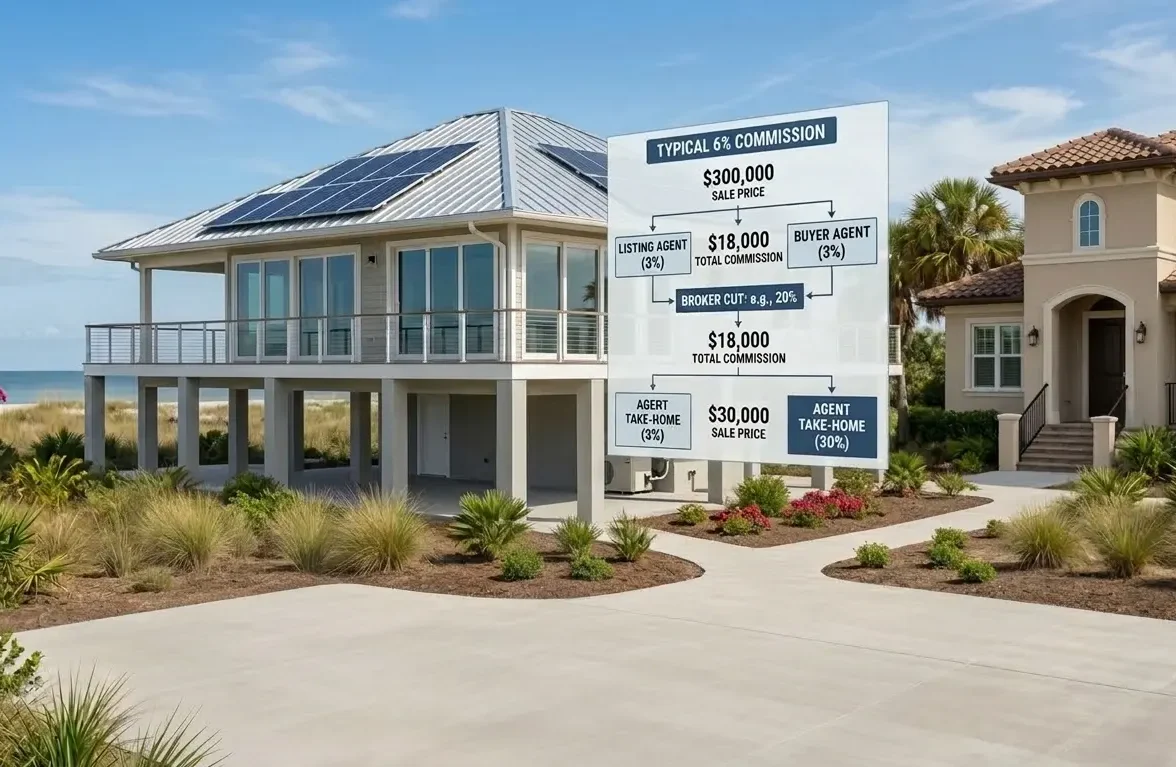
Realtor fees in Florida average about 5.3% of the sale price in 2026, usually split between the listing agent and the buyer’s agent at roughly 2.6% each. Clever Real Estate’s August 2026 survey of Florida agents put the statewide total at 5.29%, a little under the national figure of 5.46%. On a $250,000 home in Putnam County, that is about $13,225, taken out of the seller’s proceeds at closing rather than paid out of pocket.
Selling in Palatka or Putnam County? Start with a free home valuation from a local Palatka realtor so you can see your likely net proceeds before you sign anything.
That average is a starting point, not a rule. Commission is negotiable, and since the 2024 NAR settlement, sellers and buyers each agree on their own agent’s pay in writing. Below I show what fees look like at real Northeast Florida price points, who pays what now, what you can negotiate, and what a seller actually walks away with.
Realtor fees in Florida at common price points
The table uses the August 2026 statewide average of 5.29% total, with 2.64% to each side. Your agreement may be higher or lower.
Sale price | Total fees (5.29%) | Listing side only (2.64%) |
$200,000 | $10,580 | $5,280 |
$250,000 | $13,225 | $6,600 |
$350,000 | $18,515 | $9,240 |
$421,500 (Florida median sale, July 2026) | $22,297 | $11,128 |
Average real estate commission in Florida: what the 2026 data says
Surveys land in a narrow band. Clever’s August 2026 survey of 61 Florida agents found 5.29% total. Trackers still quoting Clever’s February 2026 survey show 5.57%. Clever also found Florida listing commissions typically range from 1% to 4%, which tells you how much room there is to negotiate.
Averages only go so far in Putnam County, where waterfront, acreage and lot size move prices more than in a city subdivision. That is why every listing I take starts with a comparative market analysis from real recent sales in your area, and we talk about fees alongside that number, so you see both together.
Who pays realtor fees in Florida after the NAR settlement?
What changed in August 2024
The NAR settlement practice changes took effect nationwide on August 17, 2024, and Florida is included. Two rules matter most to you:
- Buyers now sign a written agreement with their agent before touring homes. It states what the buyer’s agent will be paid.
- Offers to pay the buyer’s agent can no longer be posted in the MLS. They are negotiated directly, usually as part of the offer.
What sellers usually pay
The seller pays the listing agent from the sale proceeds. Many sellers also agree to cover the buyer’s agent as a concession, because a buyer who must pay their own agent has less cash for the down payment and closing costs. Skipping it can shrink your buyer pool, especially at entry-level price points where cash is tight.\
What buyers pay
A buyer owes whatever their buyer agreement says. In practice the seller often covers it through a concession negotiated in the contract. If the seller doesn’t, the buyer pays it at closing. Check with your lender on how your loan program treats that fee.
How much are realtor fees when selling a house? A Putnam County net sheet
Commission is the biggest selling cost, but not the only one. Here is an illustrative net sheet for a $250,000 home in Putnam County with a buyer-agent concession.
Line item | Estimate | Note |
Listing agent (2.64%) | $6,600 | Negotiable |
Buyer-agent concession (2.64%) | $6,600 | Optional, negotiated in the offer |
Documentary stamp tax on the deed | $1,750 | $0.70 per $100 of price |
Owner’s title insurance | ≈ $1,325 | Florida promulgated rate; seller customarily pays in most of NE Florida |
Title company settlement fee | Varies by title company | Shown on your net sheet |
Total before payoff and prorations | ≈ $16,300 plus settlement fee | About 6.5% of the price |
Estimated proceeds before mortgage payoff | ≈ $233,700 minus settlement fee | Prorated taxes, HOA dues and repairs come off this |
Statewide, Clever estimates sellers pay about 3.28% in closing costs on top of commission once prorated taxes, repairs and concessions are counted. My full breakdown of those items is in the Florida closing costs guide.
Is realtor commission negotiable in Florida?
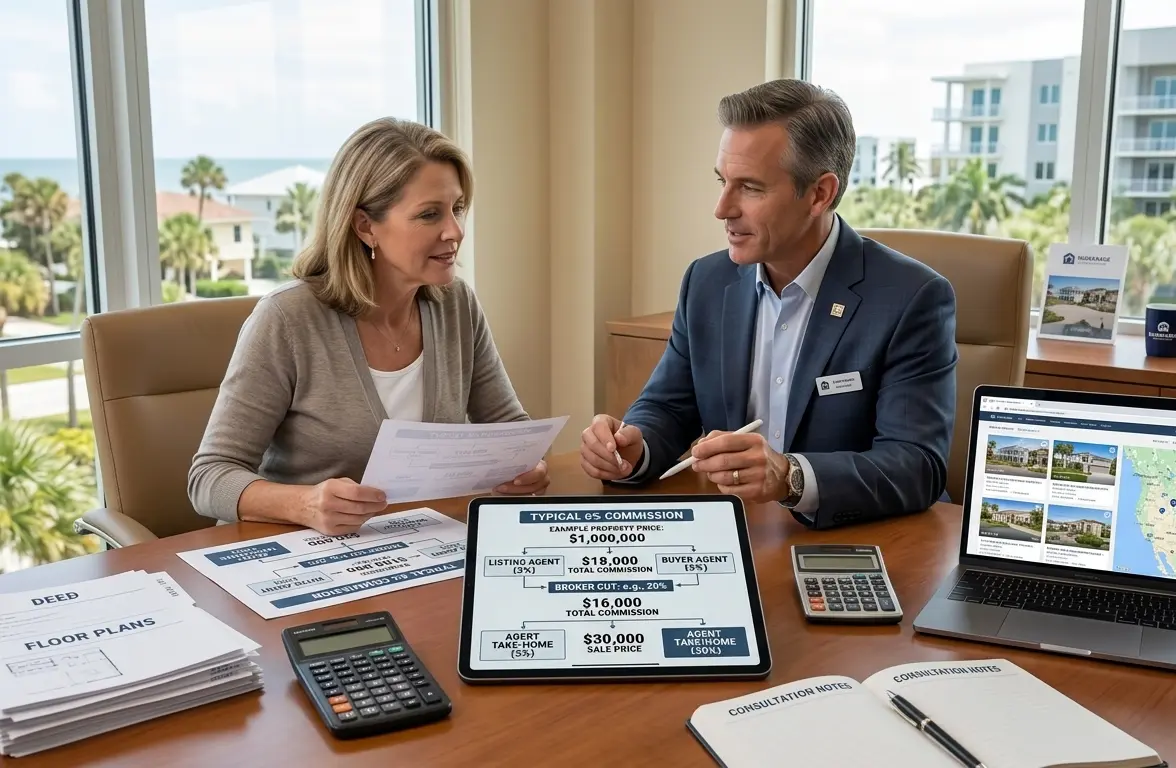
Yes. No law or board sets commission in Florida. What usually moves the number is the price point, how much work the home needs to be market-ready, how fast it is likely to sell, and which services you want included.
Before you sign a listing agreement, ask every agent you interview:
- What exactly is included: photography, video, staging advice, paid marketing, open houses?
- How did you arrive at your suggested price, and which sales did you use?
- What do you recommend on a buyer-agent concession for my price range, and why?
- How long is the agreement, and how do I cancel if it isn’t working?
- What is your fee, and what would change it?
I’ll walk you through my fee and exactly what it covers at a free first consultation. There is no obligation, no pressure and no script.
Flat-fee and discount brokers vs full-service agents
Option | Typical listing fee | Best for |
Full-service agent | About 2.5–3% | Most sellers; homes that need pricing judgment, prep or negotiation |
Discount broker | About 1–1.5% | Move-in-ready homes in active neighborhoods |
Flat-fee MLS listing | A few hundred to a few thousand dollars | Sellers who will handle showings, offers and negotiation themselves |
The fee is only half the math. In rural Putnam County, a pricing miss of 2% on a $250,000 home is $5,000, about the same as the gap between a full-service and a discount listing fee. Acreage, river or lake frontage, well and septic, and manufactured homes all make comparable sales harder to read, and that is where local pricing pays for itself.

How I work with sellers in Palatka and Clay County
I’m a full-time Realtor with Timber To Tides Realty in Palatka, with nearly 60 closings and more than $14.2 million in sales volume across Putnam County and Northeast Florida. Every listing starts with a comparative market analysis built from real recent sales near you, followed by professional photography, marketing to active buyer databases and targeted social campaigns for Northeast Florida buyers. You work with me from the first conversation to closing, with no handoffs and no assistants.
If you are weighing whether and when to sell, my step-by-step guide to selling a home in Florida, covers the whole process, and these home staging tips for Florida sellers cover prep.