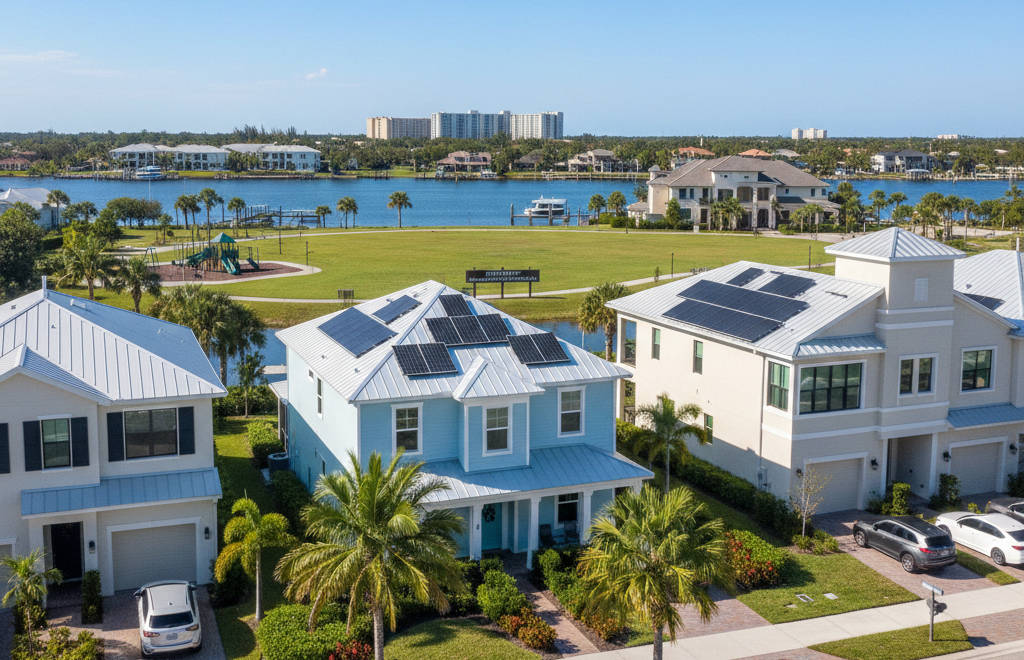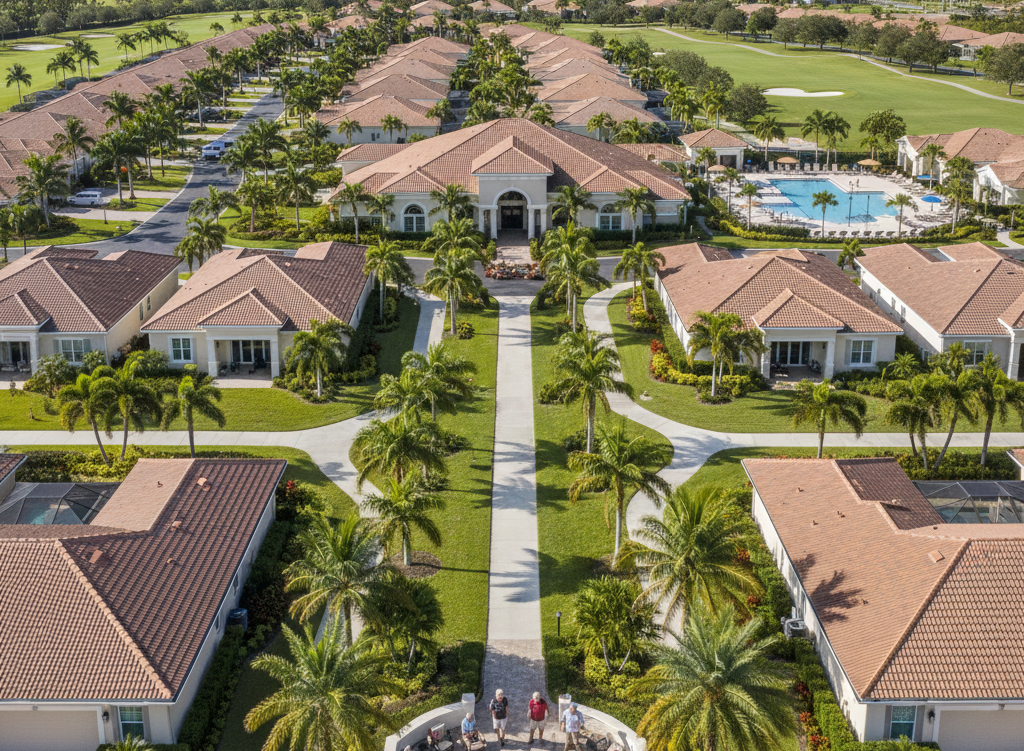


A CDD fee is a charge that shows up on your property tax bill, not on an HOA invoice, and many buyers of new homes in North Florida do not notice it until they read the closing paperwork. It can add roughly $100 to $350 a month to the real cost of owning a home, so it belongs in your budget before you fall in love with a house. This guide explains what a CDD is, what the fee pays for, a worked example from a St. Johns County community, and what to ask before you buy.
Figures below come from published district budgets and summaries and change every year. Always confirm the exact assessment for the specific lot you are buying. This guide is general information, not financial advice.
What Is a CDD in Florida?
CDD stands for Community Development District. It is a special-purpose local government created under Chapter 190 of the Florida Statutes, and developers commonly use one in master-planned communities to finance roads, drainage, utilities, and amenities. The district sells bonds to pay for that infrastructure, and homeowners repay the bonds through an annual assessment.
The assessment is billed as a non-ad valorem line item on your county property tax bill, which means it is paid with your taxes, usually in the fall, not monthly to a management company. Unpaid CDD assessments carry the same consequences as unpaid property taxes.
The Two Parts of a CDD Fee
- Debt service. This repays the bonds used to build the neighborhood’s infrastructure. It runs on a fixed schedule, often 20 to 30 years, and ends when the bonds are paid off. Some lots can pay off the debt portion early, so ask whether that is possible.
- Operations and maintenance. This pays for ongoing upkeep, insurance and staffing for community facilities. It does not expire, and the district board re-adopts it each year, so it can rise.
How Much Do CDD Fees Cost?
Published ranges vary by community. Most Florida summaries put total annual CDD assessments between roughly $1,300 and $4,500 per home. A published summary of the RiverTown district in St. Johns County, based on the district’s adopted fiscal year 2025 budget, lists an assessment of about $1,996 to $2,662 per residential unit per year. About $1,490 to $1,987 of that was operations and maintenance, and about $506 to $675 was bond debt service, depending on the bond series and lot.
Those numbers are one example, not a rule for every community. The exact figure for a lot appears on the county tax bill and the district’s assessment roll.
What a CDD Does to Your Budget
An annual charge is easy to ignore, so convert it to a monthly figure and compare it with your loan.
| Annual CDD | Per month | Loan amount it removes at an illustrative 6.5% rate |
|---|---|---|
| $1,500 | $125 | About $19,800 |
| $2,000 | $167 | About $26,400 |
| $2,662 | $222 | About $35,100 |
| $4,000 | $333 | About $52,700 |
The last column is simple math: at a 6.5% 30-year rate, each $100 of monthly payment equals about $15,800 of loan. Your lender will include the CDD assessment when it calculates your debt-to-income ratio, so a home in a CDD can qualify for a smaller loan than an otherwise identical home outside one. Run your own numbers with our mortgage calculator and read our guide to the monthly cost of owning a home in Florida.
CDD Fees vs HOA Fees
Many new communities charge both. They are different things:
- A CDD is a unit of local government. Its fee is collected through your tax bill once a year.
- An HOA is a private nonprofit corporation. Its dues are paid directly to the association, usually monthly or quarterly, and they pay for rules enforcement, amenities and common-area upkeep.
For a full breakdown of HOA costs and rules, see our HOA fees guide for Florida.
Where CDDs Appear in North Florida
CDDs are most common in newer master-planned communities. In North Florida, buyers meet them in places like RiverTown and Nocatee in St. Johns County and in some newer Clay County neighborhoods. If you are shopping new construction, read our guides to new construction in Nocatee, new construction in Clay County and new construction in North Florida. Older neighborhoods and most homes in Putnam County are less likely to have one, but you should still check.
What to Ask Before You Buy
- Is this lot in a CDD? Ask the listing agent and look at the property tax record.
- What is the exact annual assessment for this lot? Ask for the current tax bill or the district’s assessment roll.
- How much is debt service and how much is operations? Only the debt portion has an end date.
- When do the bonds mature? A shorter remaining term means a nearer end to that cost.
- Can the bond principal be prepaid? If yes, ask what it costs.
- What does the district budget say? Read the latest adopted budget on the district’s website for planned increases.
- What will my lender include in my payment? Ask for a quote with the CDD included.
Your Next Step
A CDD is not automatically a bad deal. You are paying for infrastructure and amenities through the tax bill instead of a higher purchase price, but you should know the number before you make an offer. Kassidy can pull the assessment details for any home you are considering in St. Johns, Clay, Putnam or Alachua County and help you compare it with similar homes outside a CDD. Our guide to Florida property taxes explains how the rest of your tax bill works.
Schedule a Consultation