

What buyers must know about home insurance in Florida before they close on a property could save them hundreds of dollars a month, or prevent a financial disaster after a storm. Florida’s average homeowners insurance cost hit $3,800 per year in 2026, roughly two to three times the national average of $2,543, according to January 2026 data from Insurance.com. The Florida insurance crisis 2026 is not over, but it’s shifting, and buyers who understand what’s driving costs, what’s covered, and how to cut their premium will be in a far stronger position than those who figure it out after closing. This guide covers everything you need to know before you sign.
Insurance is part of the monthly cost of any home, so it’s worth checking quotes while you search current North Florida homes for sale.
Why Is Home Insurance in Florida So Expensive?
Home insurance in Florida carries the highest average premium of any state in the country, and it’s not because insurers are being opportunistic. Florida has nearly 8,500 miles of coastline, more than any other state in the contiguous United States. It’s hit with more named storms than any other region. Construction costs have surged over the past four years, especially for roofing, concrete, and skilled labor. Litigation abuse over roof replacement claims consumed enormous insurer resources between 2019 and 2023, with Florida accounting for roughly 8% of the nation’s property insurance claims but nearly 80% of its property insurance lawsuits during that period. Those factors combined pushed dozens of carriers out of the Florida market between 2022 and 2024, leaving Citizens Property Insurance Corporation, Florida’s state-run insurer of last resort, managing as many as 1.4 million policies at its 2023 peak.
What’s Changing With the Florida Insurance Crisis 2026?
The Florida insurance crisis 2026 has entered a new phase, and the news is cautiously good. Landmark tort reform legislation passed in 2022 and 2023 eliminated one-way attorney fees and cracked down on assignment-of-benefits abuse, significantly reducing insurer litigation costs. As a result, 17 new carriers have entered the Florida market. Citizens Property Insurance has shed approximately 541,000 policies in a single depopulation year, with its active policy count dropping to around 395,000 by early 2026, the lowest since at least 2012. The insurer announced its first rate reduction in over a decade, an average cut of 8.7% statewide, with reductions as high as 14.1% in Broward County. However, according to Insurify’s March 2026 Insuring the American Homeowner Report, a further 2% rate increase is projected statewide by year-end, driven by rising rebuild costs. The honest picture is a market that’s stabilizing, not recovering, and buyers shouldn’t plan on dramatically lower bills anytime soon.
What Does Home Insurance in Florida Actually Cover?
A standard Florida homeowners insurance policy covers four main areas. Dwelling coverage protects the structure of your home including walls, roof, and foundation. Other structures coverage applies to detached garages, fences, and sheds. Personal property coverage includes furniture, appliances, and clothing. Liability protection covers legal and medical costs if someone’s injured on your property. Most policies also include additional living expenses coverage, typically 20 to 30% of your dwelling amount, which pays for temporary housing if your home becomes uninhabitable after a covered loss. What Florida buyers often don’t realize until it’s too late is what a standard policy specifically excludes.
What Home Insurance in Florida Does NOT Cover
Flood damage is never included in a standard homeowners policy. This is the single most misunderstood fact about home insurance in Florida, and it catches buyers off guard more than almost anything else in a Florida closing. If water rises from the ground, whether from storm surge, river overflow, or heavy rainfall runoff, a standard policy won’t pay a cent. Flood insurance must be purchased separately, either through the National Flood Insurance Program or a private flood carrier. Sinkhole damage is also excluded from standard policies, and separate sinkhole coverage is difficult to obtain in practice. Flood insurance Florida buyers need averages around $700 to $1,000 per year for inland properties according to FEMA data, but coastal or riverside properties pay significantly more.
How Much Does Home Insurance in Florida Cost by Region?
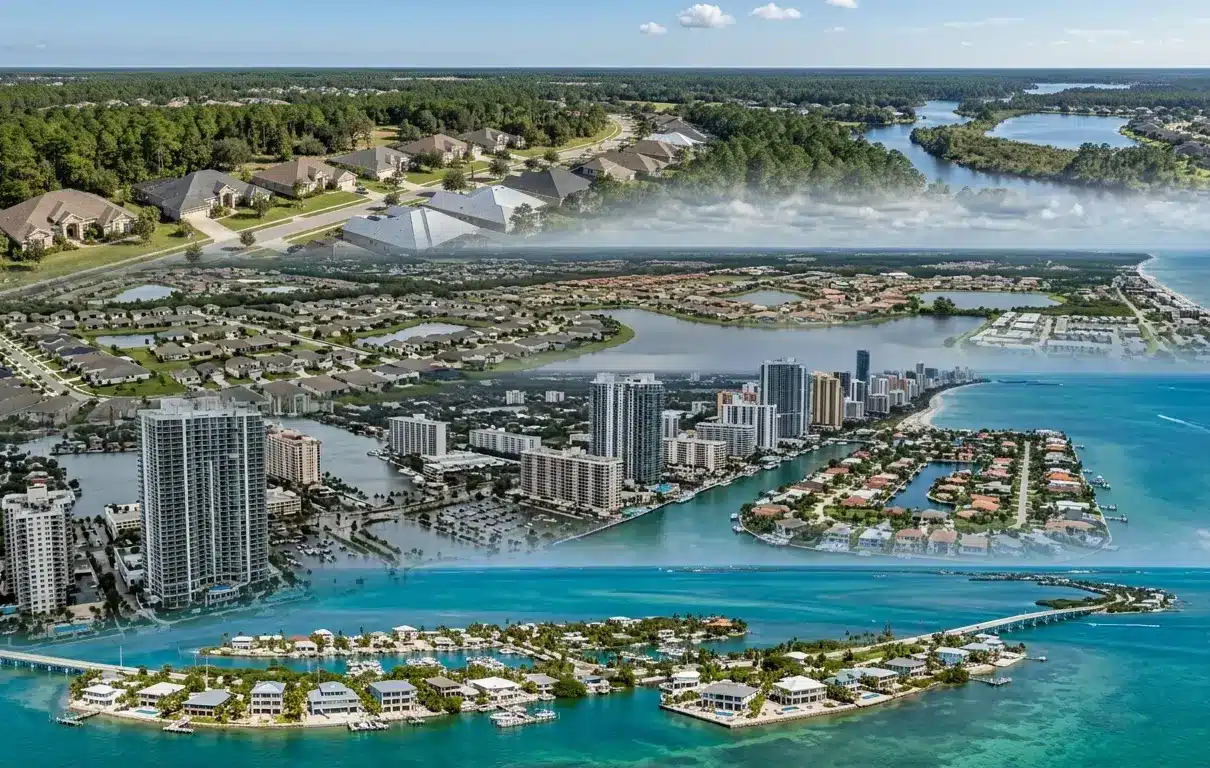
Florida homeowners insurance cost varies more dramatically by location than most buyers anticipate. North Florida counties including Duval, Alachua, and Putnam average $2,100 to $2,400 per year, making them the cheapest home insurance North Florida areas in the state. Central Florida counties including Orange, Osceola, and Polk average $2,800 to $3,200 per year. South Florida counties including Broward, Palm Beach, and Miami-Dade average $4,200 to $5,500 per year. Coastal and Keys areas, particularly Monroe County, range from $7,000 to $18,000 or more annually. Putnam County, where Palatka sits, leads all Florida counties with the lowest average annual premium at approximately $3,808, a direct result of its inland location and lower hurricane wind exposure. That’s meaningful information for buyers comparing total ownership costs across different North Florida markets. If you’re working through the full monthly cost picture, our monthly cost of owning a home in Florida guide breaks down insurance alongside mortgage, taxes, and HOA costs in detail.
Understanding Hurricane Deductibles Before You Buy
Hurricane deductibles are one of the most financially significant elements of home insurance in Florida, and one of the most frequently misunderstood. Unlike a standard deductible, which is a flat dollar amount, a hurricane deductible is calculated as a percentage of your home’s insured value. Common options are 2%, 5%, and 10%. On a home insured for $400,000, a 2% hurricane deductible means you’d pay $8,000 out of pocket before insurance covers hurricane damage. A 5% deductible on the same home means $20,000 out of pocket. Hurricane deductibles are triggered specifically when the National Hurricane Center officially designates a named storm. Choosing a higher percentage lowers your annual premium, but it substantially raises your financial exposure after a storm, so buyers need to be honest with themselves about whether they’d have that cash ready.
Your Roof Is the Single Biggest Coverage Factor
Roof age is the single most important factor determining whether carriers’ll write a policy on your home in Florida, and at what price. Most carriers won’t insure homes with roofs older than 15 years without significant premium increases or restrictions. Some won’t write new policies on homes with roofs over 20 years at all. Homes built after 2002, when Florida’s stricter post-hurricane building codes took effect, qualify for substantially lower premiums because of the wind-resistant construction standards those codes require. If you’re buying an older home, getting a roof inspection before making an offer is essential for estimating your true insurance cost. A new roof often reduces premiums by 25 to 40% according to DJ and Lindsey Real Estate’s March 2026 Florida homeowners insurance guide. The My Safe Florida Home Grant Program also provides state-funded grants of up to $10,000 to help homeowners harden their homes against wind damage, and a wind mitigation inspection costing just $75 to $150 can produce premium discounts of 20 to 40% or more.
How Flood Insurance Florida Buyers Need Works
Flood insurance in Florida operates entirely separately from your homeowners policy. The National Flood Insurance Program, administered by FEMA, offers flood coverage through private carriers but underwritten federally. If your property’s in a designated Special Flood Hazard Area, your lender’ll require flood insurance as a condition of your mortgage. Even properties outside FEMA’s high-risk zones can flood, particularly along rivers like the St. Johns in North Florida. FEMA’s flood maps are updated periodically and your zone designation can change after purchase. Checking your FEMA flood zone designation and getting a flood insurance quote before you make an offer isn’t optional, it’s essential. If you haven’t mapped out how property taxes add to your total cost burden alongside insurance, our Florida property taxes explained guide is worth reading before you start shopping.
How to Lower Florida Homeowners Insurance Cost
There are concrete steps buyers can take to reduce Florida homeowners insurance cost before and after they purchase. Shopping multiple carriers is the single most impactful action, since Florida’s more competitive 2026 market means quotes can vary by $1,000 or more for identical coverage. Getting a wind mitigation inspection produces discounts of 20 to 40% on the wind portion of your premium. Raising your hurricane deductible from 2% to 5% reduces your annual premium noticeably but increases your post-storm financial exposure, so only do this if you’d have the cash to cover it. Buying newer construction or a home with a newer roof qualifies you for lower base rates from the start. Bundling home and auto insurance with the same carrier typically saves 10 to 25%. And if you’re a first-time buyer still working through all the financial layers of a Florida purchase, our first-time home buyer in Florida guide covers how to budget for insurance from the very start of your home search rather than treating it as an afterthought.
Citizens Property Insurance: What Buyers Should Understand
Citizens Property Insurance Corporation is Florida’s insurer of last resort, not a first choice. It’s available for buyers who can’t find home insurance in Florida through the private market, and it’s been the policy home for millions of Floridians during the crisis years. But Citizens has specific limitations worth understanding. Its policies carry assessment risk, meaning that if a major hurricane overwhelms Citizens’ reserves, all Florida policyholders including those with private carriers can be assessed a surcharge to cover the deficit. Citizens is also actively depopulating, which means buyers who start with a Citizens policy may find themselves transitioned to a private carrier during their ownership period. In 2026, the private market is competitive enough that most buyers in North Florida and inland markets should be able to find private coverage, and shopping aggressively is worth doing before defaulting to Citizens.
How Haus of Klosing Helps North Florida Buyers Navigate Insurance
The Real Cost Conversation Most Agents Skip
Kassidy Babcock is a licensed Northeast Florida realtor based in Palatka with nearly 60 closings and more than five years serving buyers across Putnam County and the wider North Florida region. Home insurance in Florida is one of the first conversations she has with every buyer she works with, because the premium difference between a property in a flood zone and a property one street outside of one can be $2,000 or more per year on identical homes. That’s a number that changes whether a home’s actually affordable, and buyers deserve to know it before they fall in love with a listing.
Honest Numbers Before You Fall in Love With a Property
Through her work with buyers across Putnam County, Palatka, and surrounding North Florida communities, Kassidy’s seen a consistent pattern: buyers who hadn’t budgeted for Florida homeowners insurance cost end up surprised at closing when their lender’s escrow calculation adds $350 to $500 per month above what they’d planned. Her approach is to walk every buyer through a realistic total monthly cost, including insurance, before they go under contract, not after.
Built-In Local Knowledge on Risk Zones and Roof Age
Kassidy’s familiarity with specific neighborhoods across North Florida means she can flag potential insurance challenges before they become closing surprises. She knows which areas near the St. Johns River carry flood zone designations, which older neighborhoods have aging roofs that’ll drive premiums up, and which newer construction communities offer the lowest insurance costs in the region. If you’re thinking about a purchase anywhere in North Florida and want guidance that accounts for the full monthly picture, reach out to Kassidy here before you start your home search.